

As we ride the tailwinds of our country’s 250th birthday there is no better time than now to focus on the American Dream as it applies to homeownership. Setting down roots and owning a home fully embodies our country’s Constitutional mandate to “the pursuit of happiness”. Homeownership offers a number of important benefits: long-term financial security, a sense of community, and the personal freedom to customize living space without landlord restrictions. Homeownership gives our younger generations “skin in the game” which leads to better civic participation. It’s no wonder that homeownership has long been the cornerstone of the American Dream. But today that dream is far out of reach for many, particularly first-time buyers. It’s clear that saving the American Dream of homeownership must become a top priority if we are to escape becoming a nation of renters.
RENTING VS. BUYING

On the surface one might ask, “What’s wrong with renting?” Well, nothing and sometimes it makes sense to rent. If rents are dramatically cheaper than buying, which tends to be the case right now, then you are wise to hold off on buying until conditions are better. And if your plans are to stay in an area for five years or less, then again, renting makes more sense. The main problem with renting vs. buying is that it cheats people out of building wealth. This equity building when a home is purchased can amount to upwards of over $150,000 over about a decade. In addition to the benefits of shelter and stability that homeownership provides, the ability of people to build wealth over time is critical to the overall financial wellbeing of the individual and by extension, the country.
WHAT THE NUMBERS SAY
The Federal Reserve’s 2024 survey data shows that 68% of renters cited an inability to afford a down payment as a reason for renting rather than buying. Another 49% said they could not afford the monthly mortgage payment, while 42% said they could not qualify for a mortgage. A lack of affordability is at the root of other troubling statistics which show historic highs: 33% of adult children 35 and under continue to live in their parents’ home and a record 49% of adult children 18-25 years old have remained at home. And it’s not because these young people don’t have jobs: Roughly 70% of 25 to 34-year-olds living at home are employed, indicating a housing affordability crisis rather than a failure to launch.
More Numbers to Notice:
- Buyers under 40 make up only 29% of the buyer pool, down approximately 10-20% from ten years ago.
- Only 21% make up first-time buyers, contracting by 50% since 2007 (the year before the Great Recession).
- Buyers under 40 have a median household income of $94,400 which is below the amount needed (roughly $110K-$130K) to afford a standard 10% to 20% down payment based on a median home value of roughly $450,000 plus current interest rates, property taxes, and insurance. Since 2019 the income needed to buy a single-family home has doubled but wages have not kept pace.
- Only 37% of renters under 40 can afford the monthly cost of owning a typical home, down from 56% in 2019.
- The cost of delayed homeownership until age 40 instead of 30 can mean losing roughly $150K in equity.
HOW THIS AFFECTS THE REAL ESTATE INDUSTRY

A rising tide lifts everyone, and nowhere is this more true than in real estate. The real estate industry flourishes when the volume of housing transactions are plentiful. Today’s lack of affordable housing has greatly dampened transaction volume and forces a shift to luxury and high-density development in order for builders to secure profit margins. This creates extreme competition, stifles geographic mobility and intensifies regulatory pressures for brokers. The takeaway for real estate professionals who desire to remain in the industry and thrive means that transaction volume must go up. This in turn requires more starter homes and more affordable housing so that first-time home buyers can participate in the housing market. The real estate market is the backbone of the American economy and its impacts can be felt across a wide swath of professions, from construction, to home goods, to building materials, appraisers, title companies, and so forth.
Although high interest rates and a shortage of starter homes have restricted buyer access, experts also cite the problem of a complicated web of local, state and federal regulations, especially when it comes to zoning. Investor purchases of single-family dwellings have contributed to the shortage problem. Added to that is the NIMBY movement (Not In My Backyard) from existing homeowners, who account for two-thirds of households nationwide. Established neighborhoods often oppose development near them for various reasons, including over-crowding, increased traffic, noise, fears of declining property values, and a change to the character of the neighborhood–and so on. NIMBY movements have been a powerful obstacle to increased housing inventory. Localized opposition frequently results in density limits, strict growth boundaries, and single-family zoning, which directly block multifamily and affordable developments.
WHY THE DREAM NEEDS SAVING
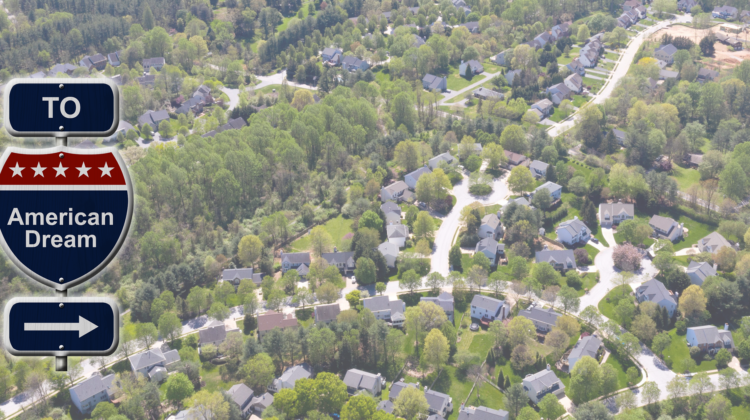
Of course, there is a more important reason to care about affordable housing and The American Dream than job security. The United States is, arguably, the best, most sought-after nation to live due to the quality of life it offers. There are many reasons for this, one of them being the ability of the middle-class to own their own home. Why is this so important? The Urban Institute puts it this way: “A nation of homeowners fosters greater economic stability, as property owners build long-term equity and accumulate significantly higher net worths than renters. It also encourages civic engagement; homeowners have a vested financial interest in their neighborhoods, leading to stronger local communities and lower residential turnover.” Stronger communities and a population of citizens that has skin in the game leads to a stronger, more united country. Happy, healthy people make a happy, healthy country.
WE DID IT BEFORE, WE CAN DO IT AGAIN
There are solutions to close the housing shortage of 1.5 – 4 million homes but it’s not going to be a quick fix so identifying solutions right now is paramount. One can look to the past to learn what has worked before. The glory years for first-time homebuyers from the middle class came right after WWII and were a result of several important Federal Government policies. These policies were designed specifically to open wide the doors of homeownership in the U.S. and represented a critical move on behalf of the Federal Government to subsidize homeownership for the middle class. These included such things as creation of the 30-year fixed mortgage, slashing down payments, and heavily subsidizing home loans for veterans all of which we consider to be “normal” today. These legislative shifts—most notably the GI Bill and expanded FHA programs—transformed the U.S. from a nation of renters into a nation of homeowners and it greatly transformed Americans’ quality of life for the better. No other generation before or since the Baby Boomers has reaped more benefits of the homeownership expansion those programs brought. Baby Boomers continue to hold most of the housing wealth in the United States today as a result but many of these homes remain off the market due to aging in place, punishing tax implications and the lock-in effect of ultra low interest rates during Covid.
Our country faces the ever-worsening dilemma of an affordable housing crisis which has brought about the lowest homeowner rates in history for first-time homebuyers. It’s clear that the time has come for meaningful interventions designed to address years of neglect resulting in today’s stressed housing market. The Federal Government has an important responsibility to ensure fair housing practices and disable exclusionary policies that prevent the construction of new homes. It’s imperative that our young people have the opportunity to own a home. Hopefully all of us can work together to design ways that help first-time homebuyers get a foot in the door and begin their homeownership journey.
Learn more about the most recent housing act to become law.
Read: